Feedback Loops
AI agents naturally optimize for getting a task done quickly. Without constraints, they copy existing patterns blindly, take shortcuts that pass linting, and produce code that "works" while quietly damaging maintainability.
The goal isn't to make agents productive. The goal is to make them produce high-quality changes consistently — and the mechanism that does that is feedback.
Feedback loops are the core mechanism
The central idea is simple:
Agents improve when they continuously receive feedback about the code they generate.
This mirrors how experienced engineers actually work. Good engineers don't trust their intuition, their memory, or their first implementation. They rely on systems that validate their work — types, tests, reviewers, CI. AI agents should operate the same way.
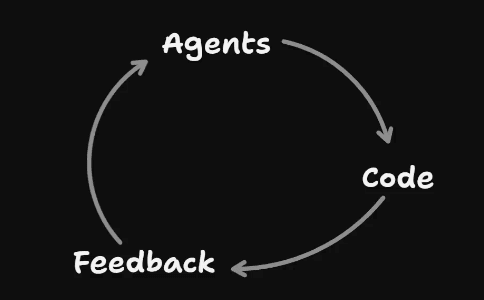
Strong feedback loops
Two patterns sit at the foundation of any AI-assisted workflow.
Type systems
Strong typing gives the agent immediate correction signals. TypeScript catches invalid types, typos, incorrect interfaces, and unsafe assumptions — every one of which is a free piece of feedback the agent can act on without human involvement.
Compared to weakly-typed systems, the quality difference in AI output is dramatic. A tsc error is a precise, deterministic, machine-readable instruction that says "do this differently."
Automated tests
Tests provide behavioral validation. They verify business logic, edge cases, regressions, and integration correctness. The principle:
The better the test suite, the better the AI-generated code.
AI gets significantly more reliable when it can:
- Make a change
- Run the tests
- Observe the failures
- Self-correct
- Re-run
That loop converts an autoregressive token generator into something that behaves much closer to an engineer.
The "do-work" pattern
Rather than reinventing the workflow each session ("implement this feature" and hope for the best), it's useful to formalize one. A reusable workflow skill like do-work standardizes how an agent contributes to a repository.
The workflow itself is a simple loop:
1. Understand the task
The agent reads the PRD, explores the repository, gathers context, and identifies affected systems. (See Tackling Big Tasks for the PRD + plan setup.)
2. Plan the work
Optional for small tasks. For larger ones: break the work into phases, define implementation steps, identify dependencies, reduce ambiguity before writing code.
Planning is often more valuable than implementation speed.
3. Implement the change
Only after context and planning. The agent modifies features, services, UI, or infrastructure — but implementation alone is not the finish line.
4. Validate through feedback loops
This is the most important stage. The agent runs the validators it has available:
pnpm run typecheck
pnpm run test
The loop becomes:
write code → receive feedback → fix issues → repeatThis is what turns AI from a code generator into a self-correcting engineering system.
5. Commit the work
Once validation passes, the agent stages changes and finalizes the unit of work.
AI committing code is not dangerous if strong feedback loops exist. Commits are reversible. The real danger is unvalidated code.
Skills should be concise
A surprisingly important lesson: skills should not be verbose. Large instruction sets create noise, reduce flexibility, and compete with the repository for the agent's attention.
The most effective skills typically contain:
- A simple workflow
- A few clear rules
- Strong feedback loops
Lightweight steering, not micromanagement. The repository — not the skill file — is what shapes the agent's behavior at scale.
The repository is still the source of truth
Even with the best skill in place, the codebase dominates AI behavior (covered in detail in Software Quality in the AI Era). If the repository contains bad architecture, inconsistent patterns, weak testing, or poor abstractions, the agent will replicate them.
Skills help guide behavior. They do not override repository quality.
AI works best in structured environments
A major takeaway from working with agents at scale:
AI coding quality is highly dependent on engineering infrastructure.
High-performing AI environments typically have:
- Strong typing
- Automated tests
- CI pipelines
- Modular architecture
- Clear conventions
- Small feedback cycles
AI isn't replacing engineering discipline. It's amplifying its importance.
The bigger shift
Traditional development looked roughly like:
human writes code → QA finds bugs laterAI-assisted development moves toward:
AI writes code → automated systems validate instantly → AI self-correctsThe shift produces tighter loops, faster iteration, and dramatically higher engineering leverage. The future value isn't generating more code — it's designing systems where humans, agents, tests, and tooling form a continuous quality feedback system.
Core takeaways
- AI without feedback loops accelerates entropy.
- Strong tests and strong typing dramatically improve AI output.
- Skills create repeatable engineering workflows — keep them lean.
- The best AI workflows mimic disciplined human engineering habits.
- Repository quality matters more than prompts.
- AI performs best when continuously validated.
- The future of engineering is feedback-driven system design, not just code generation.
Further reading
- Building Effective Agents — Anthropic's engineering post on self-correcting agent loops (the evaluator-optimizer pattern behind this article's framing).
- The TypeScript Handbook — the canonical reference for the type system that turns a
tscerror into free, machine-readable feedback. - Advanced Context Engineering for Coding Agents — HumanLayer's plan-then-verify workflow, showing why repository quality drives agent output.
Next: how to make these validation steps mandatory instead of optional — see Deterministic Feedback Loops.
Edit this page on GitHub